A working mother came into our office last week, her B.A. mark sheet in one hand and her toddler's school bag in the other. She wanted to become a teacher. She just wasn't sure if that meant quitting her job. It's the question we probably field more than any other at this point — regular or distance — and honestly, it deserves better than a generic sales pitch.
There's no single right answer here. There's a right answer for your life, your schedule, and what you can actually give up for the next two years. So let's actually get into it.
What's the Real Difference Between Regular and Distance B.Ed?
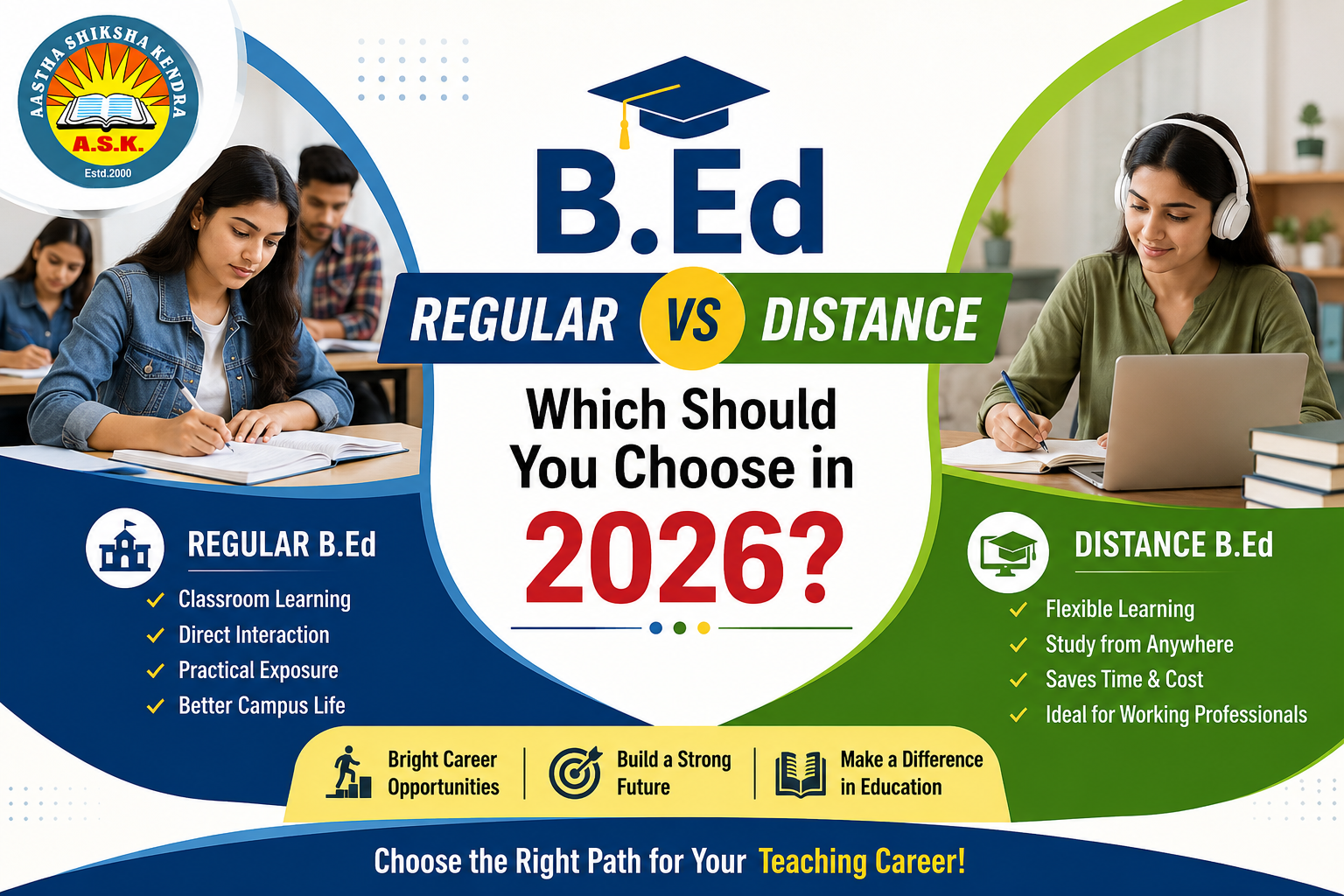
Regular B.Ed means you're on campus, most days of the week, for two years straight. You're in lectures, sitting through workshops, and doing your teaching practice with a faculty member watching over your shoulder. It's built for someone whose weekdays genuinely belong to them right now.
Distance B.Ed works around your life instead of asking you to rearrange it. You get your study material upfront, show up for contact classes on weekends or in short scheduled blocks, and complete your practical training in a more condensed window rather than spread across daily college hours. And here's the part people often miss — as long as it comes from an NCTE approved B.Ed institution tied to a recognized university, the degree itself carries the same weight either way.
Regular vs Distance B.Ed at a Glance
- Attendance: Regular is daily and on campus. Distance is weekend or periodic contact classes.
- Who it suits: Regular fits fresh graduates with no job to juggle. Distance fits working professionals and parents.
- Fees: Regular tends to run higher because it covers campus facilities. Distance is usually lighter on the pocket.
- Teaching practice: Regularly spreads it through the year. Distance schedules it in blocks.
- Recognition: Identical, provided the institute is NCTE approved and university-affiliated.
Who Should Actually Choose Regular B.Ed?
If you've just wrapped up graduation and haven't started working yet, regular B.Ed gives you something distance mode simply can't replicate as well — daily contact with classmates, faculty who can correct you on the spot, and teaching practice that builds gradually instead of in a rush. A lot of the fresh graduates we talk to about B.Ed Admission 2026 end up leaning this way, mostly because nothing in their calendar is stopping them.
It also tends to suit people who need structure imposed on them from outside. If you know you do better with a fixed timetable than with self-discipline alone, regular mode plays to that.
Who Benefits More From Distance B.Ed?
This is where most of our recent enquiries actually come from — people already working as untrained teachers, para-teachers, or private tutors, who need the qualification to move into a proper, government-eligible teaching career without walking away from their current salary.
Distance B.Ed also makes sense if you're managing a household, live somewhere without a nearby regular-mode college, or you're simply someone who learns fine on your own with occasional guidance rather than daily hand-holding. We've seen candidates well into their thirties and forties complete distance B.Ed while working full jobs, which just isn't realistic under a regular-mode schedule.
Does the Career Value Actually Differ Between the Two?
Not as much as people assume. What recruitment bodies and school managements actually check is whether the university is recognized and whether the institute is NCTE approved — not which mode you studied in. Tick both boxes, and a distance B.Ed course opens the same doors as a regular one: DSSSB eligibility, KVS and NVS applications, private school hiring, all of it.
The one exception worth knowing about is that a handful of government recruitment drives occasionally specify regular-mode graduates only. It doesn't happen often, but it's worth reading the eligibility clause of whatever post you're eyeing before you commit to a mode.
What About Fees and Duration?
Regular B.Ed usually costs more, and that's mostly because the fee is covering things students don't use — labs, libraries, sports facilities, sometimes hostel accommodation. Distance B.Ed fee structures tend to be lighter since you're really paying for study material, contact sessions, and evaluation.
Duration-wise, both run roughly two years under NCTE norms. Where distance mode pulls ahead is flexibility — you're not locked into a rigid academic calendar the way regular students are.
A Few Questions Worth Asking Yourself
Before you lock anything in for B.Ed Admission 2026, sit with these honestly:
- Can I actually show up for daily classes for two years, or does my income or family situation rule that out?
- Do I need someone else's structure to stay disciplined, or can I manage self-paced study with occasional check-ins?
- Is there a specific job posting I'm aiming for that insists on regular-mode graduates?
- What can I realistically afford — a higher fee plus two years with no full-time income, or a mode that lets me keep earning while I study?
There's genuinely no universal winner. A fresher with time on their hands and a working parent juggling a job both come out the other end as qualified teachers — they just take different roads to get there.
At Ask Institute, we've sat across the table from both kinds of students, and our advice never really changes: pick the mode that fits the life you're actually living, not the one that sounds more impressive on a form.
Frequently Asked Questions
Is distance B.Ed valid for government teaching jobs?
Yes — as long as it's from an NCTE-approved B.Ed institution affiliated with a recognized university, distance B.Ed is accepted for DSSSB, KVS, NVS, and most state-level teaching recruitment, barring the rare notification that insists on regular mode.
Which is cheaper — regular or distance B.Ed?
Distance B.Ed usually costs less since it skips daily campus infrastructure. Regular B.Ed costs more but comes with full access to labs, library, and campus facilities.
Can I do distance B.Ed while working full-time?
Yes, that's essentially the whole point of a distance B.Ed course. Study material and self-paced learning fit around a job, with contact classes typically falling on weekends or in short blocks.
Is the teaching practice component different in distance mode?
The requirement itself is the same under NCTE norms — distance mode just schedules it in condensed blocks rather than spreading it across daily college hours.
Which mode is better right after graduation, for B.Ed Admission 2026?
If nothing is stopping you from attending daily classes, regular B.Ed generally gives fresh graduates deeper hands-on exposure before their teaching career starts. Distance remains just as recognized, though, if your circumstances call for flexibility instead.