A parent called our office last month asking if we could "fix" her son's B.Ed degree — turns out the college he'd enrolled in two years earlier had never actually held valid NCTE approval. Nothing to fix at that point. This kind of thing happens more often than it should, and it's almost always avoidable. So here's what "government approved" actually means for a B.Ed program in Haryana, which universities genuinely qualify, and how you check before you commit rather than after.
What Does "Government Approved" Mean, Really?
The university has to be recognised by Haryana's state education department and hold current NCTE approval — without both, the degree won't count for teacher recruitment exams or school hiring, no matter how good the college website looks.
Here's where people trip up. A college can be a perfectly legitimate, functioning institution and still not have valid approval for its B.Ed program specifically. General recognition and program-specific recognition aren't the same thing. Before handing over any admission fee, ask for:
- The NCTE recognition certificate for the B.Ed program itself, not a general accreditation letter
- Proof the institute appears on Haryana's Department of Higher Education list
- An affiliation number you can actually look up, not one someone reads off to you over a phone call
- Names or numbers of recent graduates who cleared TET, CTET, or HTET
If a college can't produce these without stalling, walk away. It really is that simple.
So Which Haryana Universities Actually Qualify?
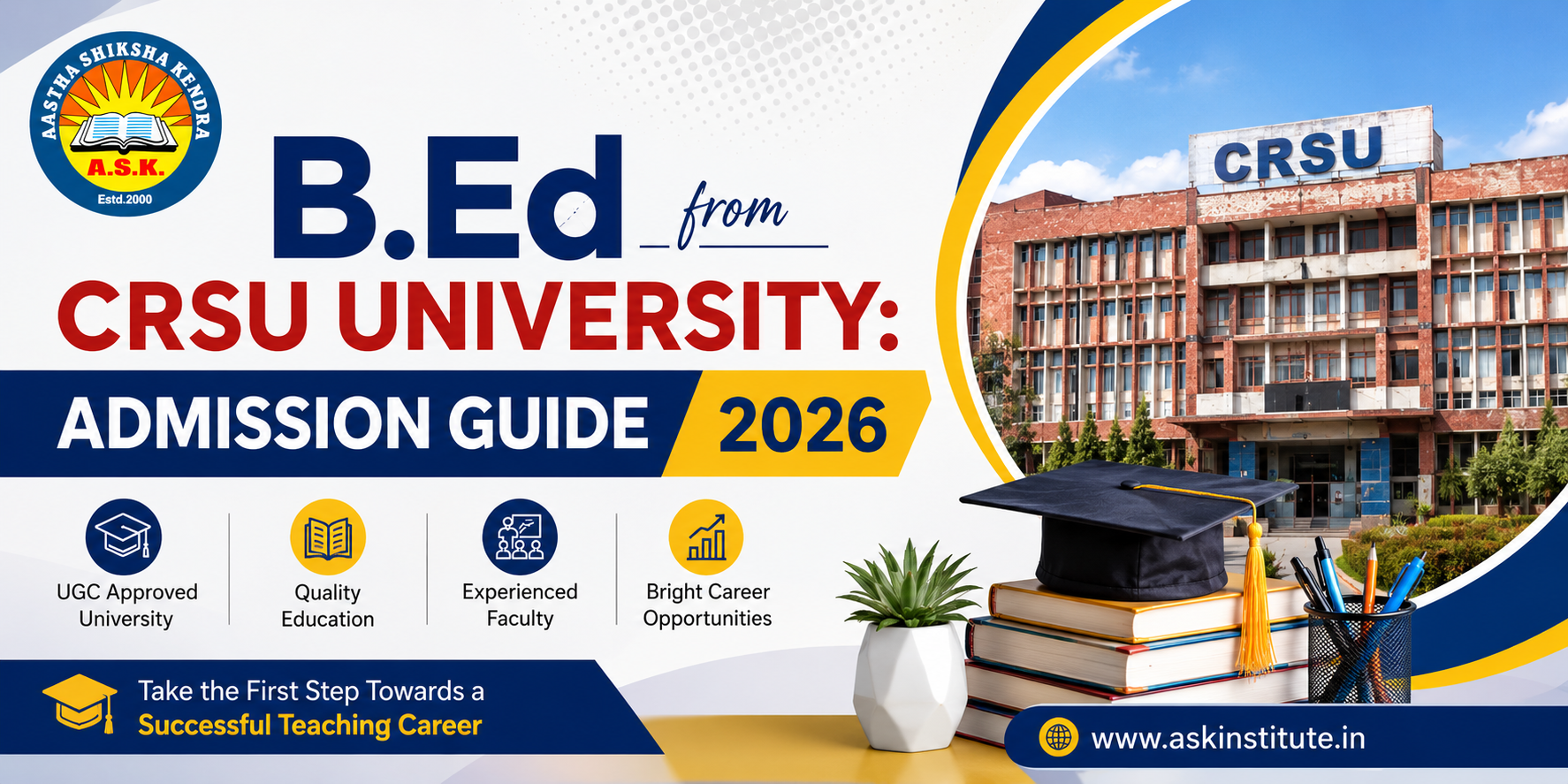
Maharshi Dayanand University (MDU) Rohtak and Chaudhary Ranbir Singh University (CRSU) Jind are the two names that come up most often, and for good reason — both run properly structured two-year B.Ed programs under NCTE's framework, with syllabi that track NEP's teacher-training guidelines.
A misconception I run into constantly: students assume the "main campus" degree is somehow more valuable than one earned through an affiliated college. It isn't. Same syllabus, same exam pattern, same degree — as long as the affiliation is currently active. That last part is the catch most people miss.
Things worth actually checking before choosing an affiliated college:
- Has the affiliation been renewed this academic year? (Colleges don't always advertise when it lapses.)
- Is there real campus infrastructure, or is space being borrowed/shared with another institute?
- Do they have working relationships with local schools for internship placements?
- Who's teaching the practical training component, and what are their actual qualifications?
How Do You Verify This Yourself?
Two steps, maybe ten minutes total. Check the institution on NCTE's official portal, then cross-reference against the university's own list of affiliated colleges. Both should say the same thing. If they don't line up, that's your red flag — don't ignore it because the brochure looks nice.
We build this verification step into our counselling process before anyone finalises their B Ed Admission, mainly because we've seen what happens when families skip it. Ten minutes now versus two wasted years later isn't much of a trade-off.
What's the Eligibility Criteria?
Generally you'll need a bachelor's degree with around 50% marks (45% if you fall under a reserved category) from a recognised university, and in many cases, a valid entrance test score.
That percentage isn't fixed in stone across every college, so don't go by a number a cousin mentioned three admission cycles ago — pull the current year's notification. Broadly speaking though, expect:
- A completed graduation degree (BA, BSc, BCom, or equivalent) from a recognised university
- The minimum aggregate the university specifies, with standard relaxation for SC/ST/OBC candidates
- An entrance test score, where the university requires one
- Sometimes an age limit, buried in the fine print of that year's admission notice
And a question that comes up constantly: is B.Ed distance education treated the same as a regular degree for job eligibility? Yes, but only when that particular distance program has its own separate NCTE approval — which, frankly, not every provider bothers securing.
What Documents Should You Have Ready?
Your graduation mark sheets, entrance exam scorecard, category certificate if it applies, a government photo ID, and passport photos. Nothing exotic, but forgetting even one of these can cost you a counselling slot during peak admission weeks.
Getting this together early makes the whole B Ed Admission process considerably less stressful — seats move fast once counselling opens. A working checklist:
- Final degree certificate and mark sheet
- Entrance test admit card and result
- Category certificate, where relevant
- Domicile certificate for state quota applicants
- Aadhaar or another valid photo ID
- A handful of recent passport photos — most offices want at least four on hand
What Do B.Ed Fees Actually Look Like in Haryana?
Cheaper than private institutes, generally speaking, though I won't pretend to give you a fixed number here — fee structures shift almost every admission cycle, and quoting an outdated figure does nobody any favours. What stays consistent is the gap: government and government-affiliated seats cost meaningfully less than fully private, self-financed programs, especially once you factor in reserved-category relaxations.
Your best move is calling the admission office directly rather than trusting a number from an old forwarded PDF or a two-year-old blog post (including, frankly, ones like this).
Does Any of This Actually Matter Later?
More than most people expect going in. A properly recognised degree affects whether you're even allowed to sit HTET or CTET, how smoothly a private school's HR team verifies your paperwork, whether you can move on to an M.Ed at a recognised institution, and — if you ever relocate — whether the degree is even accepted outside Haryana.
I've watched students find out mid-course that their college's affiliation had lapsed without anyone telling them. By then there's not much left to do but transfer, repeat coursework, or start over somewhere else. All of it is avoidable with one phone call before enrolment.