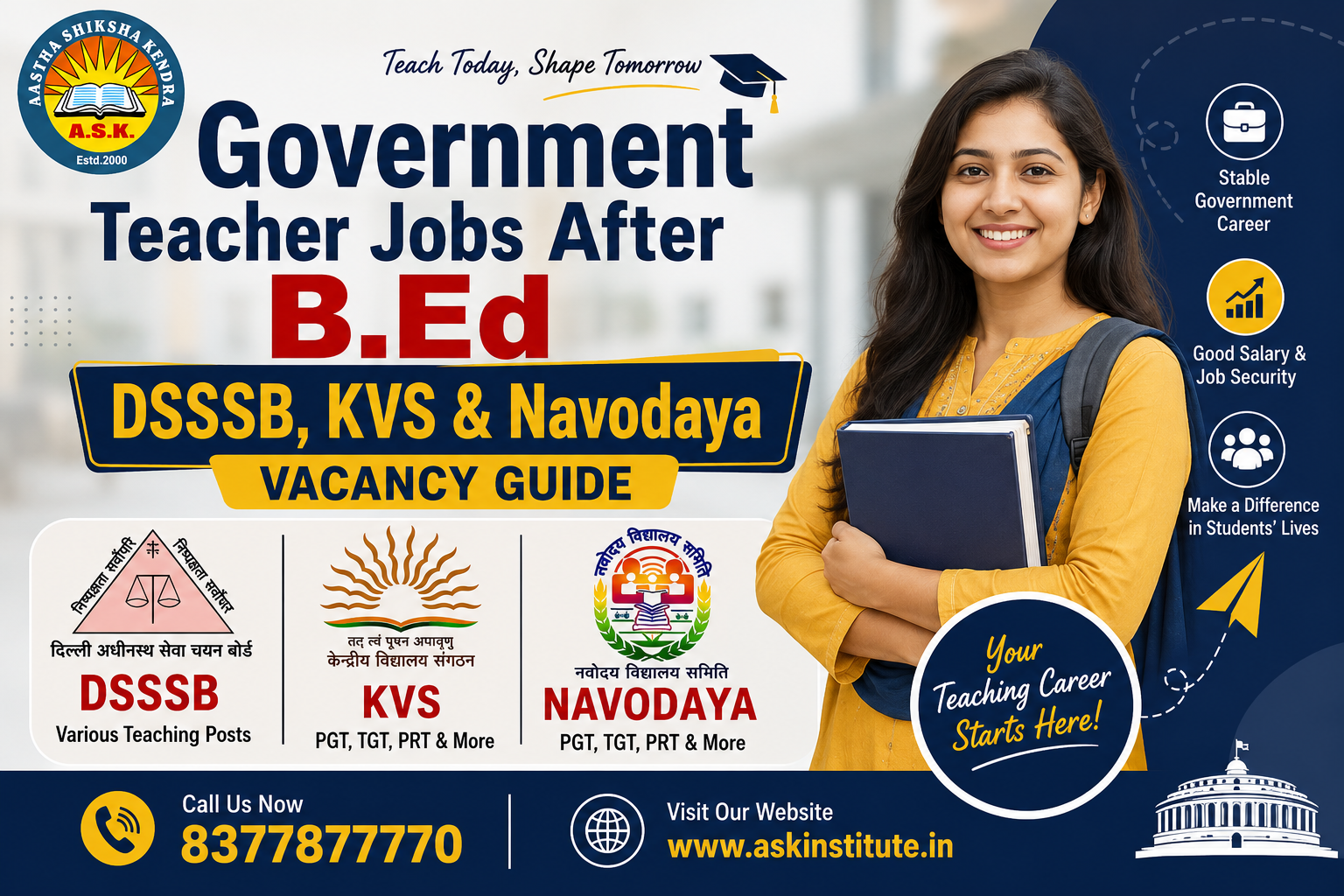
Getting your B.Ed done is a big milestone, but it's not the finish line. The real challenge starts after — figuring out which government body will actually hire you, and what each one expects. In India, three names come up again and again for teaching jobs: DSSSB, KVS, and Navodaya Vidyalaya. They sound similar on paper but work very differently once you dig in. Here's a clear breakdown so you know exactly where you stand and what to do next.
DSSSB: Delhi's Own Teacher Recruitment Board
DSSSB handles hiring for Delhi government schools across three levels — Primary Teacher (PRT), Trained Graduate Teacher (TGT), and Post Graduate Teacher (PGT).
If you're aiming for a TGT post, you'll need a graduate degree in your teaching subject along with a B.Ed and a valid CTET pass certificate. Most posts cap the applicant's age around 30 years, though category-based relaxation applies.
For PGT posts, the bar goes up — a postgraduate degree with at least 50% marks in your subject, plus a B.Ed from an institute recognised by NCTE. The maximum age generally allowed is 36 years. Teaching experience isn't compulsory, but if you already have some, it adds weight to your application.
DSSSB doesn't sit quiet for long — new vacancy notifications drop almost every year, sometimes running into several hundred posts across subjects at once. The exam is fully computer-based, objective-type, running about three hours, and carries negative marking for wrong answers, so accuracy matters as much as knowledge.
KVS: For Pan-India Postings and Job Stability
Kendriya Vidyalaya Sangathan runs schools mainly for children of central government employees who get transferred across the country. This is a favourite among B.Ed holders because postings aren't limited to one city — you could end up teaching in any state.
Here's something most people get wrong: a B.Ed alone won't get you a PRT post at KVS. Primary teaching there is reserved for D.El.Ed, B.El.Ed, or Special Education diploma holders. Your B.Ed becomes relevant starting from the TGT level upward.
For TGT roles, you need a bachelor's degree with 50% marks in your subject, a B.Ed, and CTET Paper-II cleared. The age ceiling usually sits around 35 years. For PGT roles, a postgraduate degree with 50% marks plus B.Ed is expected, and the age limit stretches a bit further, typically up to 40 years.
Selection isn't a one-shot exam either. It runs in stages — an initial qualifying test, followed by a second, more detailed written stage, and finally an interview or demo teaching round. Your final rank depends heavily on how you perform in that second stage, since it carries the bulk of the weightage.
Navodaya Vidyalaya: Teaching Beyond the Cities
Jawahar Navodaya Vidyalaya schools are spread across nearly every district in India, and most of them sit in rural or semi-rural areas rather than metro cities. The recruitment process here mirrors KVS fairly closely — a bachelor's or master's degree depending on the post, B.Ed as your professional qualification, and CTET as a mandatory add-on.
What sets Navodaya apart is the lifestyle that comes with the job. Many of these schools are residential, meaning teachers often live right on campus. If you're someone who's open to relocating away from a city and prioritises job security over choosing your posting location, this path is genuinely worth exploring.
DSSSB vs KVS vs NVS — Side by Side
|
Criteria |
DSSSB |
KVS |
NVS |
|
Who Recruits |
Delhi Government |
Ministry of Education |
Ministry of Education |
|
Posting Area |
Delhi only |
Anywhere in India |
Mostly rural districts |
|
PRT Eligibility |
B.Ed accepted |
D.El.Ed / B.El.Ed only |
D.El.Ed preferred |
|
TGT Eligibility |
Graduate + B.Ed + CTET |
Graduate + B.Ed + CTET-II |
Graduate + B.Ed + CTET-II |
|
PGT Eligibility |
Postgraduate + B.Ed |
Postgraduate + B.Ed |
Postgraduate + B.Ed |
|
Selection Rounds |
Single computer test |
Two-stage test + interview |
Written test + interview |
|
Residential Duty |
Not required |
Not required |
Usually required |
Getting Ready Before Vacancies Even Open
You don't have to wait for your B.Ed results to start preparing. CTET can be attempted while you're still finishing your final year, and clearing it early puts you a step ahead the moment recruitment notifications drop. Keep checking the official sites regularly, since application windows often close within just a few weeks of opening.
One thing candidates underestimate — TGT and PGT exams test your actual subject knowledge from graduation, not just teaching theory. So brushing up on your core subject alongside pedagogy topics genuinely helps when the exam day arrives.
Conclusion:
DSSSB, KVS, and NVS aren't rivals competing for the same candidate — they're different paths depending on where you want to work and how flexible you are about location. Whichever one you choose, a recognised, NCTE-approved B.Ed remains the one qualification every single board insists on. The rest is a matter of clearing CTET, knowing your subject well, and applying on time.
FAQs
Q1. Can a B.Ed holder apply for KVS PRT posts?
No. KVS PRT posts require D.El.Ed, B.El.Ed, or a Diploma in Special Education. A B.Ed qualifies candidates for TGT and PGT positions instead.
Q2. Is CTET mandatory for DSSSB teaching posts?
Yes. DSSSB generally requires a valid CTET certificate along with a B.Ed and the relevant subject degree for TGT and most teaching posts.
Q3. What is the upper age limit for KVS PGT recruitment?
The upper age limit is generally 40 years for PGT posts. Age relaxation is available for reserved categories as per government rules.
Q4. Do Navodaya Vidyalaya teachers have to live on campus?
Yes, in most cases. JNV teachers are expected to stay on the school campus, as these are residential schools serving rural and remote areas.
Q5. Which offers better career growth: DSSSB or KVS?
Both offer excellent career opportunities and similar government pay scales. KVS provides all-India transfer opportunities and broader exposure, while DSSSB offers stable postings within Delhi.